Reimagining Big Basin: A Vision for Recovery
By Mary Andersen
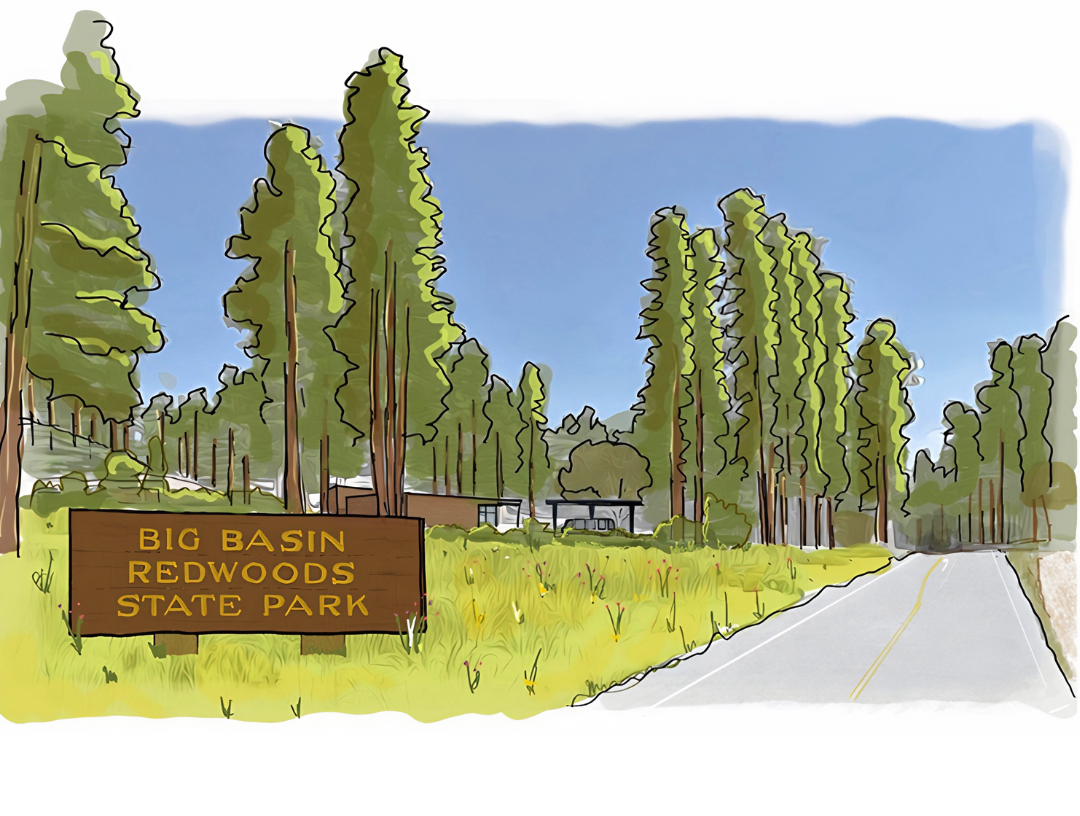
Image above: The proposed Saddle Mountain welcome center will provide an entry to the park, welcome center and shuttle parking to access the park on weekends. The hub will will overlook a restored meadow and include a park store and bistro.
Nearly five years after the CZU Lightning Complex Fire tore through California’s oldest state park, the vision for Big Basin Redwoods State Park is taking shape — not as a return to the past, but as a forward-looking restoration that aims to balance ecological integrity, cultural inclusion, and public access.
In June, California State Parks released a detailed draft of its Facilities Management Plan for Big Basin, alongside a Notice of Preparation of a Supplemental Environmental Impact Report (EIR). The ambitious plan — born from years of community and partner engagement, rigorous environmental assessment, and Indigenous consultation — signals a significant milestone in the journey to rebuild a beloved landscape from ashes.
A New Chapter for California’s Oldest Park
Big Basin Redwoods State Park, established in 1902, is not only California’s first state park, but also home to ancient coastal redwoods, some more than 2,000 years old. Before the devastating CZU Fire in August 2020, the park welcomed close to 1 million visitors annually. Nearly all of its infrastructure was destroyed in the blaze — including visitor centers, campgrounds, and ranger residences.
Reopened in 2022 through a limited access day-use system operated by Friends of Santa Cruz State Parks, Big Basin has since seen over 150,000 visitors. Still, access remains restricted, with limited parking, no potable water, and only 30 miles of trails cleared and open out of 115.
Now, the newly unveiled Facilities Management Plan outlines a park-wide rebuilding strategy rooted in the principle of “Reimagining Big Basin.” The plan honors the park’s natural and cultural legacy while introducing modern solutions that reflect lessons learned from wildfire and climate resilience.
Nature First: Restoration in the Old Growth Core
One of the most striking features of the plan is the ecological sensitivity shown toward the park’s prized old growth redwood forest. Previously, extensive infrastructure was woven into this delicate area including campgrounds, paved roads, and the historic park headquarters. Under the new plan, much of this is removed or scaled back.
The footprint of human development in the core forest will be reduced by 50%. The former headquarters site will be reimagined as a low-impact day-use hub with modest amenities, a shuttle drop-off point, and interpretive features. Blooms Creek, Sempervirens, and Wastahi Campgrounds — once situated directly within the old growth — will be retired and the land restored to redwood habitat. In their place, new trail camps and group picnic areas will allow for more sustainable engagement.
Hydrological restoration is another major component. Streams diverted long ago will be reconnected, meadow systems will be revived, and boardwalks will provide accessibility while protecting recovering ecosystems.
Access, Stewardship, and Adaptation

The Facilities Management Plan focuses on five areas of the park: Saddle Mountain, the Old Growth Core, Overnight Areas, Upper Sky Meadow, and Little Basin
The rebuilding effort is not just about recovering what was lost, it’s about designing for the future. The Facilities Management Plan divides Big Basin into five focus areas: Saddle Mountain, the Old Growth Core, Overnight Areas, Upper Sky Meadow, and Little Basin.
At the gateway to the park, a new Saddle Mountain Hub will serve as the primary entrance and orientation center. With a visitor center, café, camp store, shuttle stop, and meadow restoration area, Saddle Mountain will be the park’s welcome mat. Visitors will park here and use a new shuttle system or transit from Scotts Valley to access the old growth and other areas, reducing vehicle congestion and protecting sensitive habitats.
Campgrounds will be relocated outside the old growth zone, primarily to Huckleberry, Lower Sky Meadow, and Little Basin. Across the park, facilities will include a mix of car camping, hard-sided cabins, walk-in tent sites, and group camps. These spaces are designed to accommodate a range of visitor experiences.
Upper Sky Meadow will offer quiet, scenic walk-in sites and rustic group facilities. And a fully accessible campfire center and Junior Ranger gathering space will help nurture future generations of outdoor stewards.

Saddle Mountain Hub: A) Shuttle parking, B) Main Visitor Center, C) Operations and maintenance hub, D) Park store, gear lending library, and Big Basin Bistro, E) Meadow restoration, F) Shuttle and bus boarding, G) Off highway queuing for parking check-in, H) Shuttle charging, I) Short term parking, J) Left turn lane.
Honoring Indigenous Stewardship at Little Basin
Perhaps the most profound evolution in the park’s design is its recognition of Indigenous history and the integration of tribal partnership into park planning. The land known today as Big Basin is the ancestral homeland of the Amah Mutsun Tribal Band and the Muwekma Ohlone Tribe. The rebuilding effort at Little Basin places Indigenous presence and stewardship at the center of its vision.
A new Tribal Cultural Stewardship Center will support Indigenous-led restoration, cultural activities, and ecological education. A shared-use area will include cabins for tribal members, a communal kitchen and ramada for events, and interpretive trails highlighting traditional ecological knowledge. Some group campgrounds at Little Basin will be reserved for tribal use only.
These efforts mark a shift toward cultural restoration alongside environmental recovery. Restoring not just the forest, but relationships to place and history.

Main Day Use Area: A) Hydrological reconnection, B) Trails camps and reservable group picnic, C) Auto tree viewing platform, D) Former headquarters steps interpretive site,
E) Reservable day use parking, F) Expanded meadow and boardwalk, G) Restrooms, H) Redwood ecology interpretive center, I) Shuttle arrival, J) Former lodge reflection area,
K) Picnic area, L) Old growth amphitheater, M) Hydrological restoration.
Resilience
Fire-resilient design is woven throughout the plan. All buildings will use fire-resistant materials and be designed with defensible space. Staff housing, which is essential to park operations and emergency response, will be consolidated into safe zones with both co-housing and single-family units.
The shuttle transportation system is another resilience strategy, not only easing visitor pressure on sensitive areas but also providing more equitable access. On busy weekends, Santa Cruz Metro will partner with the park to expand bus service from Scotts Valley. Focus on car access is diminished with the hope that visitors will turn toward public transportation. This part of the plan is of concern to the San Lorenzo Valley main street business community and should be addressed in upcoming meetings.
A Call for Public Participation
California State Parks is inviting the public to participate in the next phase of planning. A public webinar is scheduled for Thursday, July 10, from 6 to 7:30 pm, offering an opportunity to learn about the Facilities Management Plan and the scope of the Supplemental EIR. The public comment period on the EIR is open until July 18, 2025.
After the EIR and General Plan Amendment are finalized in late 2025, phased construction will begin — ushering in a new era for Big Basin.
For more information visit reimaginingbigbasin.org. View the full project summary pdf below.

Mary Andersen is a journalist and Publisher of the San Lorenzo Valley Post, an independent publication dedicated to the people, politics, environment, and cultures of the Santa Cruz Mountains. Contact mary@slvpost.com