Mushroom Foraging in Santa Cruz County: A Beginner’s Safety-first Guide
By Mary Andersen
Mushroom foraging is one of those outdoors adventures that pairs well with drizzle, redwoods, and a hot thermos of tea. Now through February is the most productive time for mushroom hunting in our area. Santa Cruz County’s damp winters reward patient eyes – but tasty fungi come with real risks. If you’re new, start slow, learn locally, and never eat anything unless you (or a trusted expert) are 100% sure what it is.
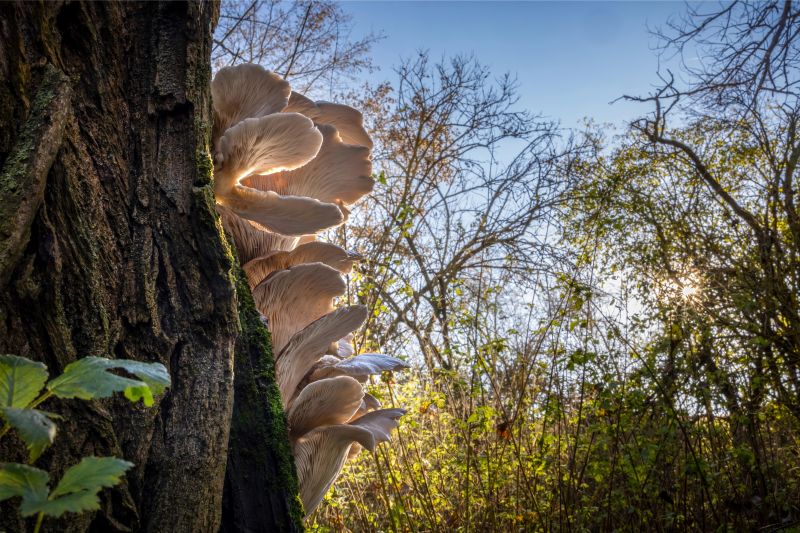
Local guides and museum pages list common edible finds in the Santa Cruz area: California golden chanterelles (Cantharellus californicus), oysters, hedgehog mushrooms, cauliflower (Sparassis), black trumpets, candy cap, porcini-type boletes and lion’s mane are all reported around the county’s oak and redwood habitats. Chanterelles in particular are a beloved local staple.
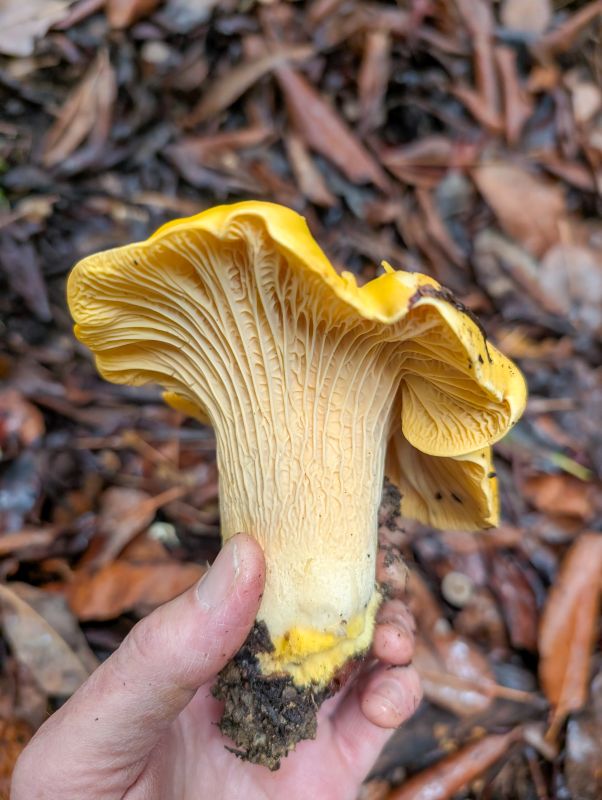
Find Golden Chanterelles (Cantharellus californicus) in the Santa Cruz Mountains in winter under live oaks, after good rains, on shaded hillsides, often buried in oak leaf litter. Focus on moist, north-facing slopes, about 2-3 weeks post-soaking rain. Be aware of lookalikes. (Photo by Julie Horner)
Safety Essentials (Read this first)
The California Department of Public Health confirmed in December, “Multiple cases of amatoxin poisoning resulting in severe liver damage and one death to date have been identified, with clusters reported in the Monterey area and the San Francisco Bay Area. These cases have been linked to consumption of foraged wild mushrooms where toxic varieties, such as death cap mushrooms (Amanita phalloides), were mistaken for familiar edible varieties with similar appearances.”
- Never eat a wild mushroom unless you’re 100% certain of its ID.
- Use multiple ID features. Don’t rely on one trait (color or smell). Check cap, gills/false-gills, stem, spore color, habitat (what tree it was near) and bruising. Cross-check with photos and keys.
- When in doubt: throw it out. Even small uncertainty can be deadly. Cooking, boiling, drying or freezing does not remove amatoxins.
- Handle, don’t assume. It’s usually fine to touch mushrooms, but never taste-test a suspect specimen. Keep foraged items separated and well-labeled.
“Some poisonous wild mushrooms look and smell like edible types of mushrooms,” said Dr. Edward Moreno, County of Monterey Health Officer. “Only people with extensive training and experience should eat wild mushrooms that they have picked themselves.”
Poisonous mushrooms can cause abdominal pain, cramping, vomiting, and diarrhea. Anyone experiencing these symptoms after eating wild mushrooms should seek immediate medical attention, as some species can cause liver damage or death. For guidance on diagnosis and treatment, patients and healthcare providers can contact California Poison Control at 800-222-1222.
How Beginners Can Get Started Safely
- Go on guided walks before you forage solo. Join a museum or mycological society walk (see events below) so you can see identifications demonstrated in the field. Many groups run January walks and talks. Mycologists are scientists who study fungi, exploring their biology, ecology, and uses in fields like medicine, food, agriculture, biotechnology, and environmental science.
- Buy a region-focused field guide and an app. Start with a regional printed guide and an iNaturalist.org or BayAreaMushrooms.org resource for photo help (see more recommendations below). Cross-check every find.
- Learn look-alikes. Study common poisonous look-alikes in California – especially toxic Amanitas and Galerina – so you can spot red flags.
- Gather tools: foraging basket, small knife, notebook, camera. Photograph cap undersides and habitat. Take specimens (whole, including base) for identification. Reminder: Never eat a wild mushroom unless you’re 100% certain of its ID.
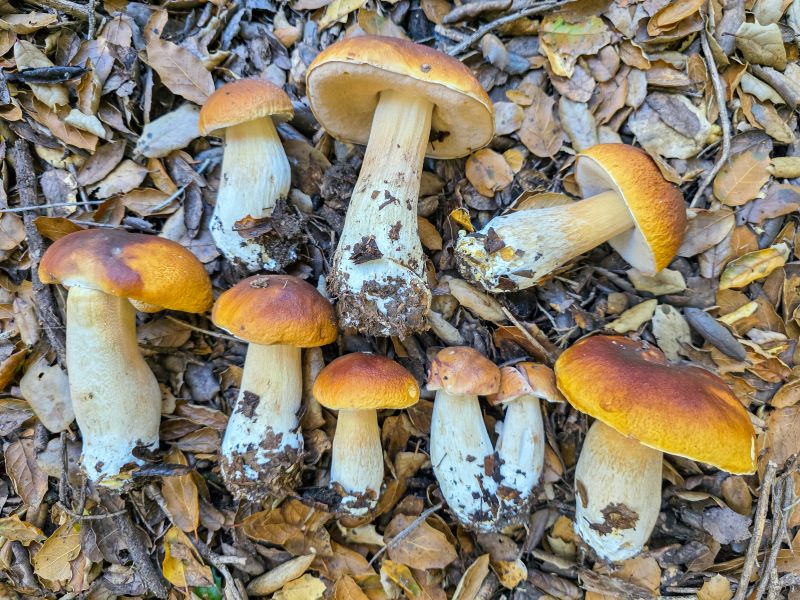
King Bolete is prized as an edible mushroom. The fungus grows in deciduous and coniferous forests and tree plantations, forming symbiotic associations with living trees. Be aware of dangerous lookalikes. (Photo by Julie Horner)
Local Guides & Groups
Several local expert groups host fairs, walks, and speaker nights. These are ideal ways to learn identification, ethical harvesting, and habitat awareness. Check their event calendars for workshops and guided forays.
The primary mushroom foraging group in Santa Cruz County is:
Fungus Federation of Santa Cruz (FFSC)
- Membership: $25 per household
- Offers local forays in the Santa Cruz and Monterey Bay areas, long-distance trips, classes on mushroom ID and mycology, and hosts the annual Santa Cruz Fungus Fair
- Contact: PO Box 82, Santa Cruz, CA 95063 | membership@ffsc.us | ffsc.us
Commercial foraging classes also operate in the area:
- ForageSF – Led by local mycologists and culinary professionals, offering guided mushroom walks in the Santa Cruz Mountains and Bay Area. foragesf.com
- Flora & Fungi Adventures – Guided excursions with chef, author, and forager Maria Finn. floraandfungiadventures.com
- Wyldforest – Offers guided foraging outings. wyldforest.com
The Santa Cruz Museum of Natural History provides educational programming and resources related to mushrooms year-round. santacruzmuseum.org
Mycological societies provide educational resources on mushroom identification for those interested in foraging wild mushrooms. For California societies, visit the North American Mycological Association at namyco.org/clubs.
Recommended Guidebooks
- California Mushrooms: The Comprehensive Identification Guide (Desjardin, Wood & Stevens). A thorough state-level reference.
- Mushrooms of the Redwood Coast (Noah Siegel & Christian Schwarz) Excellent for this region.
- Mushrooms Demystified (David Arora) Classic, deep background for hobbyists.
January Mushroom Month Events in Santa Cruz County
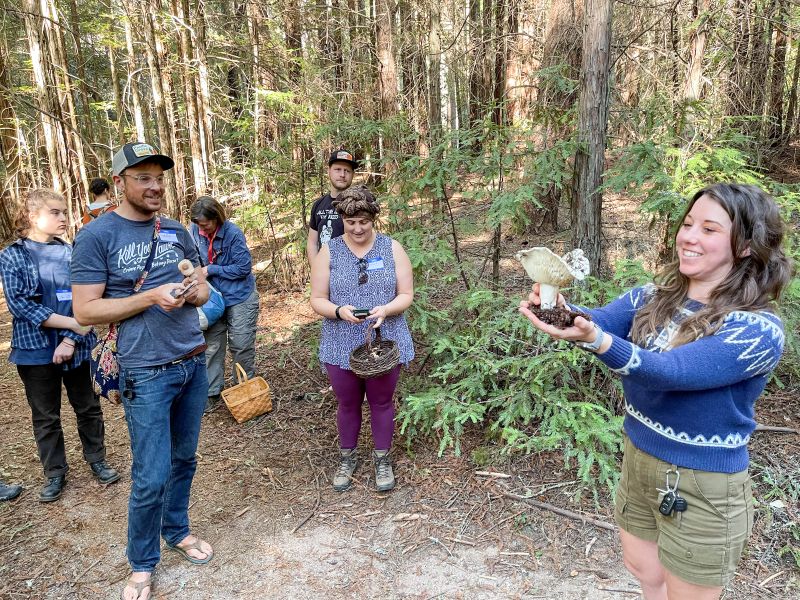
Downtown Santa Cruz Mushroom Month January 1 through 31 | 9am to 5pm
Many Downtown Santa Cruz businesses offer special dishes, displays, or products celebrating the wonder of fungus. Maps and information are available at the Downtown Information Kiosk and at Artisans & Agency 1368 Pacific Ave, Santa Cruz.
2026 Santa Cruz Fungus Fair January 9 | 2 to 5pm. January 10 and 11 | 9am to 5pmnual Fungus Federation of Santa Cruz, London Nelson Community Center 301 Center St, Santa Cruz
Come to the Santa Cruz Fungus Fair to learn fascinating and fun facts about beautiful and diverse species of mushrooms!. Enjoy talks, exhibits, and vendors. ffsc.us
Santa Cruz Fungus Fair After Hours Dinner January 9 | 5 to 9pm
Fungus Federation of Santa Cruz, London Nelson Community Center 301 Center St, Santa Cruz
Celebrate the culinary delights of mushrooms at the annual Fungus Fair After Hours Mushroom Dinner, with a gourmet menu presented by celebrity chef Chad Hyatt. ffsc.us
Mushroom Hunting Santa Cruz Sundays, January 4, 11, 18, or 25 | 10am
Wyldforest, Santa Cruz County
Take an exciting hike and learn which mushrooms are safe to eat while expanding your knowledge of the mushroom world. Meet other mushroom enthusiasts from your region and connect with like-minded people. wyldforest.com/collections/santa-cruz
Edible Mushrooms of Santa Cruz Saturdays, January 10 or 24 | 10am to 1pm
Flora and Fungi Adventures, Santa Cruz, CA
A focused mushroom foraging walk where you’ll learn to confidently identify seasonal edible species, with added insight into other wild foods of the Santa Cruz landscape.
floraandfungiadventures.com
Weekend Wild Mushroom Adventure Saturday, January 11 | 11am to 3pm
forageSF, Santa Cruz Mountains
Spend 3-4 hours in the Santa Cruz Mountains learning the basics of wild mushroom foraging. Start with a talk on ecology then explore the forest with Maya Elson, a naturalist with over 10 years of experience, as your guide. foragesf.com
Fungus Federation of Santa Cruz, Monthly Meeting with speaker Alan Rockefeller January 20 | 6 to 9pm
Santa Cruz Live Oak Grange, 1900 17th Ave, Santa Cruz
Fungus Federation members gather monthly on third Wednesdays to catch up, discuss club business, and learn from interesting speakers. Bring fungi for identification! Mycologist Alan Rockefeller has uploaded more than 700 of his own fungal DNA sequences to Genbank and is a co-author on several scientific papers. He spends hours each day identifying mushrooms for the general public. He has identified over 250,000 fungi on websites like iNaturalist, Mushroom Observer, and various Facebook Groups. ffsc.us
Mushroom Walk Saturday, February 7 | 10:30am to 12 noon
Santa Cruz Museum of Natural History 1305 East Cliff Drive, Santa Cruz
Learn how to identify and differentiate between mushroom species, learn mushroom picking and collecting etiquette, and ways of identifying fungus genus and species. Participants can participate in an illustration workshop featuring their mushrooms after the walk. santacruzmuseum.org/event/mushroom-walk
Online Class: Identify Mushrooms Safely Learn at your own pace.
Digital Mushroom Class for Beginners: Learn how to recognize mushrooms by looking at features like cap, gills, stem, habitat, and season. Edible Species: Explore a selection of approachable mushrooms you’re likely to encounter and how to tell them apart from lookalikes. Get tips on safe harvesting, handling, and simple ways to prepare your finds at home. wyldforest.com/collections/santa-cruz
For some of the above in-person events, the exact meeting location will be provided with booking confirmation.
Mary Andersen is a journalist and Publisher of the San Lorenzo Valley Post, an independent publication dedicated to the people, politics, environment, and cultures of the Santa Cruz Mountains. Contact mary@slvpost.com