Commentary: Making Sense of an Emerging Water District Controversy
By Mark Dolson
I have recently become aware of a potentially significant political controversy brewing within the San Lorenzo Valley (SLV). The issue at the heart of this debate is the (highly selective and extremely limited) use of herbicide by the San Lorenzo Valley Water District (SLVWD). The question for our community is: should we be concerned about this?
My first encounter with this issue was via a November 29, 2025 article in this paper. That article presented some relevant background information and concluded by encouraging SLV residents to speak up to ensure the safety of our local water supply.
People had an opportunity to do this at a two-hour special SLVWD Board Workshop on December 1, 2025, aimed at collecting public input and allowing Board discussion of the District’s Integrated Pest Management Plan (IPMP). Environmental Programs Manager Chris Klier explained the actions the District had taken over the past year, ten members of the public provided input (roughly three minutes per speaker), and the Directors engaged in some inconclusive follow-up discussion.
The District’s actions (hand-dabbing an annual total of ten ounces of Garlon-4 on freshly-cut stumps as a last resort method of controlling invasive plants to fulfill SLVWD’s legal obligation to protect endangered insect species in the Olympia Sandhills) were consistent with the IPMP it adopted in 2021. However, the ten members of the public viewed this as an alarming evasion of the IPMP’s underlying intent, namely the complete elimination of all pesticides on District land, and they pressed for a revision to the IPMP to remove any possible wiggle room. They expressed unanimous and grave concern about the possibility that our local water supply might be contaminated by hazardous chemicals.
In the end, the Board asked Staff to return in March with their recommended revisions, and everyone walked away with a certain amount of frustration. Members of the public found their allotted speaking time insufficient for sharing the full extent of their argument for a total ban; they were mostly able only to convey how genuinely frightened they were by the District’s actions. District Staff, in turn, were frustrated by the difficulty they experienced in persuading the public that they were not compromising their commitment to provide safe water, and that they were merely following widely-accepted best practices to balance their various responsibilities.
Unstated in this exchange was a crucial bit of additional context: this same issue surfaced in 2018 and played a decisive role in the November elections that year in which a slate of three new candidates for Board seats defeated the three incumbents. The new candidates called for a total ban on the use of glyphosate (the active ingredient in Roundup), and they viewed their victory as a public affirmation of their assertion that insufficient attention was being paid to protecting our water supply. In contrast, the incumbents accused their opponents of deceptively manipulating public opinion with baseless scare-mongering. This same scenario could potentially replay this November when, once again, voters will be responsible for filling three of the five Board seats.
How, then, should members of the public respond to the current situation? I have now spent many, many hours in deep discussion with highly knowledgeable individuals on all sides of this dispute, and I have found this to be a genuinely rewarding experience. My overwhelming reaction is that this is precisely the kind of conflict that our current society is not very good at resolving (because doing so would require a substantial time investment for all involved parties together with a highly skilled discussion facilitator, and these efforts might still end in a deadlock). In the absence of such a mechanism, I will simply offer the following highly abbreviated summary and associated analysis.
The opposing parties in this dispute actually agree on far more than they disagree on. Both are deeply committed to ensuring the safety of our water supply, and both agree that herbicides merit special attention because of their potential to inflict serious harm on humans. Where the two sides disagree, though, is in their assessment of the benefits and costs of a complete ban on herbicides. A useful understanding of this disagreement requires sensitivity to both technical issues and philosophical differences.
The District resorted to herbicide use in 2025 only on a few specific acres of its property that have proven particularly challenging to manage. One possible way to avoid this conundrum would be for the District simply to divest itself of these troublesome acres. Unfortunately, this is unlikely to be feasible. A key component of the District’s mission is “protecting the health of its aquifers and watersheds.” The District would need to find another land management entity (such as a park or land trust) to assume this responsibility, and since this is a costly responsibility, the District would likely have to pay that entity a large amount of money to cover these costs (e.g., by establishing something like a million-dollar endowment).
Absent a land transfer, the District still needs to meet its legal responsibilities (overseen by the Department of Fish and Wildlife) in the Olympia Sandhills, and it argues that: (1) its current level and method of herbicide use is negligible and consistent with both the practices of other water districts and the recommendations of academic experts in the field of Integrated Pest Management, and (2) any alternative (and yet to be determined) approach that it would be forced to invent would be more expensive and less effective. This is a predominantly technical perspective.
Proponents of a ban see things somewhat differently. They focus on the proven dangers (and the dangers yet to be discovered) of herbicides when applied indiscriminately, and they suggest that the District’s current extremely limited use of herbicide situates it on a slippery slope that will inevitably lead to less discriminating use. They repeatedly focus on worst-case scenarios (which everyone agrees are horrible), and they assert that only a complete ban will reliably avert such outcomes. They further argue that the harm that they imagine eventually resulting from ever-expanding herbicide use will have costs (e.g., payments for damages) that far exceed the increased (and currently unknown) cost of managing the land without herbicides. However, this harm is entirely hypothetical.
More generally, proponents of a ban are coming at this from a more philosophical perspective. They are fundamentally distrustful of the underlying science (because of instances of distorted research results due to duplicitous industrial involvement), and they are fundamentally distrustful of the District (which they fear will become more and more dependent on herbicides). They argue that a complete ban will give the public much-needed peace of mind and will place the District on the right side of history, ahead of its peers.
The proponents’ arguments have a certain logic, but they are ultimately asking the public to place its faith in self-appointed experts rather than trained professionals. Some people might regard this as an appealing course of action, but there is one last important detail that the proponents have so far failed to come to terms with: the annual herbicide use by the District in any plausible scenario is only a tiny fraction of the chemical contamination that is all around us from other herbicides and leaks. This means that its real-world impact is literally undetectable.
In other words, there is no measurable distinction between the District’s current policy and a complete ban. A complete ban would have symbolic significance, but it would have no practical benefit, and it would impose significant associated costs on the District. The peace of mind that a ban would confer could be just as easily achieved by having the ban proponents share this understanding more widely.
In conclusion, I am not questioning the sincerity of those who are working tirelessly to promote a total ban, and I’m not arguing that their concerns should be simply dismissed. However, I have been unable to discover any evidence that the District’s current IPMP is imperiling our community in any way.
Mark Dolson
Felton
Mark Dolson is a member of the local citizens’ group Friends of San Lorenzo Valley Water (FSLVW). FSLVW articles, initiatives, and Board meeting summaries are available online at friendsofsanlorenzovalleywater.org.
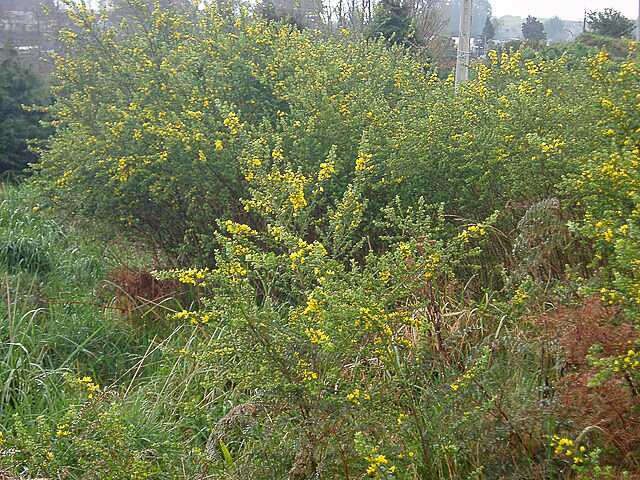
Featured photo: French Broom (Genista monspessulana). Wikimedia Commons

The San Lorenzo Valley Post is your essential guide to life in the Santa Cruz Mountains. We're dedicated to delivering the latest news, events, and stories that matter to our community. From local government to schools, from environmental issues to the arts, we're committed to providing comprehensive and unbiased coverage. We believe in the power of community journalism and strive to be a platform for diverse voices.