Among the Tallest Beings on Earth, Listening Becomes a Form of Reverence
By Mary Andersen
For those of us who live in the Santa Cruz Mountains, the presence of the redwoods is a daily comfort – a sense of being held in a place of reverence built long before roads, fences, and property lines. But few of us have ever truly heard these trees. We know the familiar sounds of needles after rain, the clatter of jays, the muted crunch of duff underfoot. What we rarely notice are the quieter layers. The sounds carried upward through 250 feet of living wood, shifting with wind, elevation, and the apparently audible heartbeat of water climbing toward the crown.
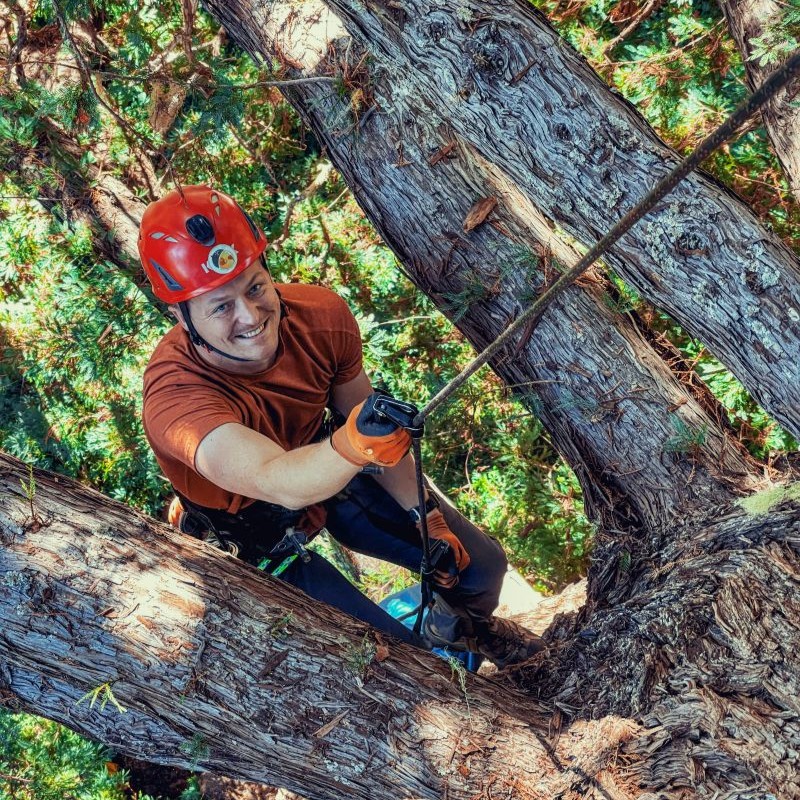
Thomas Rex Beverly is a field recordist whose recordings have been used in OSCAR, Emmy, and Golden Globe winning films and museum projects. Last year, he set out to record hidden forest auditory dimensions as part of a collaboration with microphone manufacturer Sennheiser. His work took place deep within a protected stand at Camp Jones Gulch, in the “Valley of the Giants,” where some of the tallest trees in the Santa Cruz Mountains rise. With permission from the Sempervirens Fund, Beverly was granted rare access to climb and record an ancient tree from the forest floor all the way to its upper canopy.
“More people have climbed Mount Everest than an old-growth redwood tree,” he said. “Redwoods, in particular, offer a unique perspective on nature. This project was about capturing not just the sound of the forest, but the essence of the trees themselves.” Anyone who has walked a quiet morning trail in the redwood groves at Big Basin or Henry Cowell state parks knows the weight of that statement.
Climbing Into the Vertical Soundscape
Beverly worked in the grove over two seasons, using a range of sensitive Sennheiser microphones to document the forest’s acoustics at multiple heights. His setup included a cluster of ultra-quiet condenser microphones designed for field recording – tools capable of picking up the faint tremor of wind inside the canopy or the first stirrings of dawn birdsong. One configuration, a double array using small-diaphragm mics, let him aim the microphones upward from the forest floor to catch the shifting murmur of needles tens of meters above him.
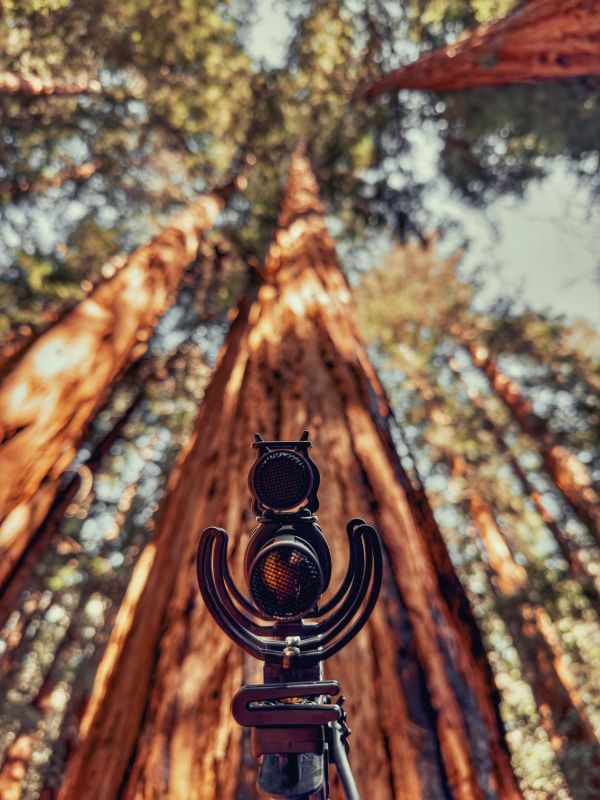
An MS stereo set-up with Sennheiser MKH 8030 and 8040 microphones.
The vertical differences were dramatic. Redwoods grow with a kind of architectural logic: branchless trunks sometimes for 150 feet or more, then a sudden eruption of limbs. Lower canopies hold wide, moisture-hungry needles; higher crowns taper to smaller foliage built for sun and wind. Beverly’s microphones captured that gradient – the airy, restless voice of the treetops, the denser hush below, and the near-silence at ground level where thick duff muffles everything.
During gusts, he said, each elevation recorded the same event with its own signature. “You could hear the wind hit 30 meters, then 60, then 70.” Like listening to different floors of the same house in a storm.
Listening Inside a Living Redwood
One of the most surprising aspects of the project happened not in the open air but within the body of the tree itself. Using contact microphones pressed gently against the bark, Beverly recorded the internal sounds of water rising through the xylem – faint crackles and ticks, the pulse of fluid traveling through centuries-old channels.
These same contact mics picked up vibrations from a variety of wildlife calls, like a raven’s croak setting the trunk humming, an owl’s low note thrumming through wood like a struck drumhead. In a forest where so much seems still, these recordings captured the tree responding physically to its environment in the moment. “It’s a whole new perspective,” he said. “And it’s conceptually and sonically fascinating to go from the environment outside the tree to the internal life of the tree itself.”
Three Days to Reach a Single Branch
To record the canopy, Beverly and two professional tree climbers spent days rigging ropes high into the crown using crossbows and fishing line. A practice well-known to canopy researchers but almost unheard of in field recording. Once aloft, they installed microphones at several heights and left some running overnight.
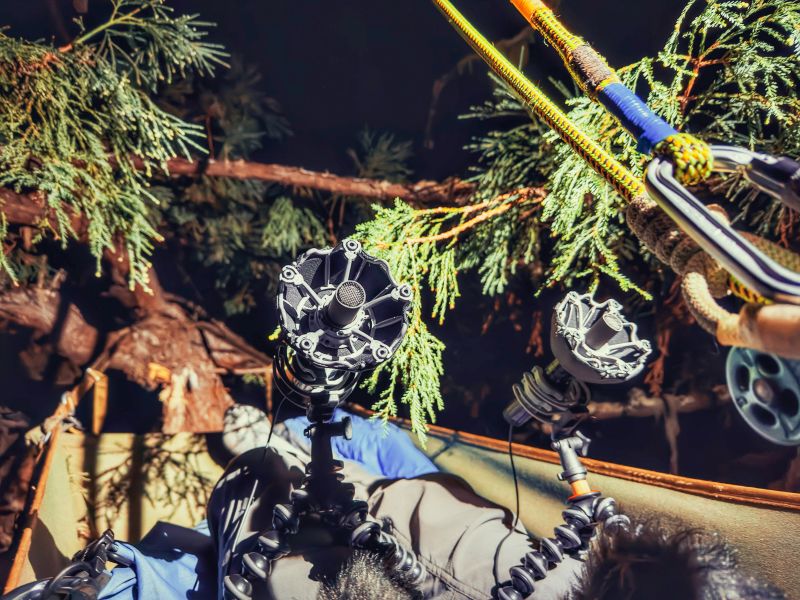
Beverly in a tree boat in the canopy with two Sennheiser MKH 8020 microphones.
At one point, Beverly slept in a tree boat nearly 230 feet up, suspended in darkness above the forest floor. “Being in a harness for hours, dealing with batteries and SD cards, while trying to attach everything to the branches was tricky,” he said.
Anyone who has camped beneath these trees knows how quiet a redwood forest can be. Hearing it from within the crown, at eye level with the stars, is another thing entirely. “For a while, there was barely anything happening,” he said. “Just the faintest wind gusts moving through the canopy, then distant owls, and the whole forest waking up at sunrise. It was incredible.”
What These Recordings Offer Us
One night, during a windstorm, Beverly captured the sound of a large redwood falling somewhere across the valley – a deep, concussive event that he described as “an explosion in the distance.” Moments like that can be both terrifying and magnificent, a reminder that these forests continue to be shaped by forces we rarely witness firsthand.
For residents of the Santa Cruz Mountains who have endured fires, floods, and years of ecological uncertainty, Beverly’s work underscores something essential: these old forests hold stories we can learn to hear. The groves that survived and are recovering from the CZU Lightning Complex fire continue to communicate in incredibly subtle ways.
Beverly’s recordings invite us to tune in with a different kind of attention. In these mountains, the redwoods are never still. They have long moved fog, wind, birdsong, and water through their bodies with a quiet cadence. Listening, in the way presented in this project, brings that deeper rhythm forward, reminding us that the redwoods are active participants in the life of our mountain home.
Listen to a sampling of the recordings at sounds.sempervirens.org.
***
Featured photo: Nature Sound Recordist Thomas Rex Beverly climbing a redwood during his expedition in the Valley of the Giants in the Santa Cruz Mountains. (Photos contributed by Sennheiser)

Mary Andersen is a journalist, publisher, and editor of the San Lorenzo Valley Post, an independent publication dedicated to the people, politics, environment, and cultures of the Santa Cruz Mountains. mary@slvpost.com