Five Years After the CZU Complex Fire, Bonny Doon is Smaller, but Closer.
By Max Guerra
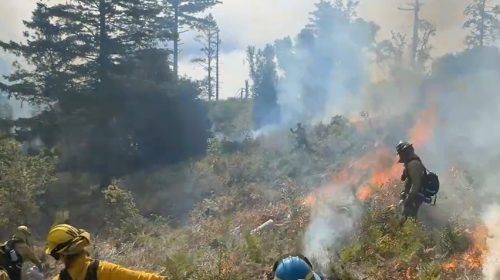
Five years after the CZU Complex Fire burned over 80,000 acres and destroyed 911 homes in the Santa Cruz Mountains, only 160 have been rebuilt, leaving many neighborhoods dramatically transformed and still grappling with the long road to recovery.
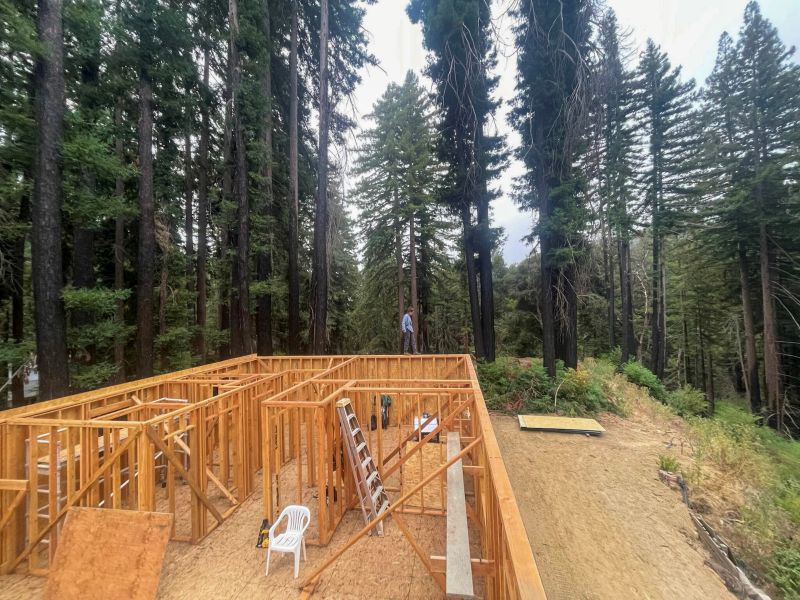
Rebuilding in the burn scar of the CZU fires has come with complex barriers. Local bureaucracy ensures that anyone who wants to rebuild has plenty of hoops to jump through — geological hazard issues, environmental health issues, septic system issues — a whole slough of requirements can get in the way of rebuilding in Santa Cruz County.
Returning to a sense of normalcy has been a long journey — one that is very different for each community member in Bonny Doon’s neighborhoods. For Ann McKenzie, who lives there, rebuilding her home took four years.
“Dealing with the insurance company and the contractors and subcontractors was a long process,” she said. “But now we’re trying to settle in and make a brand new house a home.”
McKenzie says that she ran into some snags with the permitting process, but her greatest issues came with the wet winters of 2022 and 2023. Her rebuild is almost entirely complete, but she maintains a caution to her optimism.
“We really could have used a retaining wall,” she said. The wall’s not caving in or anything, but there’s just a lot of water runoff. We’re still dealing with a lot of things fire-wise, but we’ll get there.”
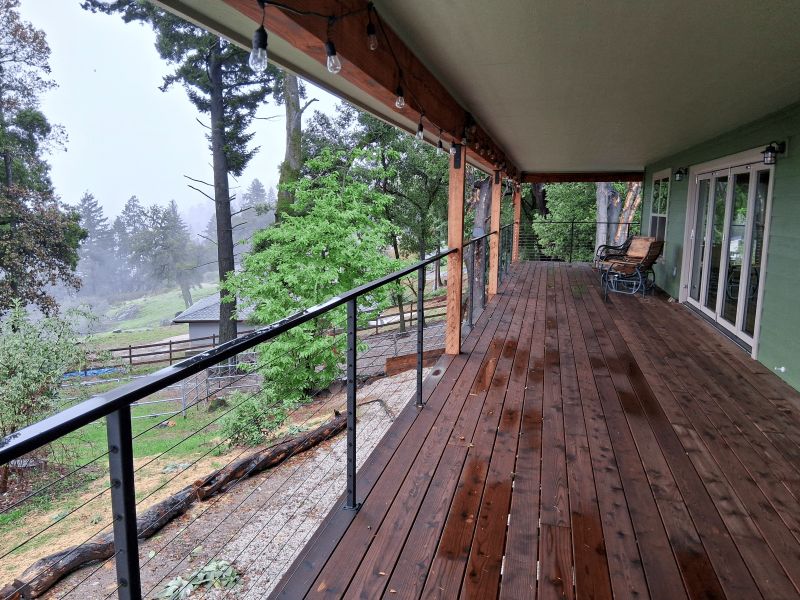
The deck of Ann McKenzie’s home looks out towards the San Lorenzo Valley. After the fire in 2020, all that remained of her home was her chimney.
In the Pineridge neighborhood specifically, making the decision to rebuild at all was a difficult one. McKenzie has watched her neighbors in Bonny Doon take different paths.
“It’s definitely a rebuilding community where we live,” said McKenzie. “In Bonny Doon we have a pretty tight community on our road and it has changed drastically with the fire.”
“One family went to Oregon, another one to Idaho,” she said. “People have moved to Arizona. People have moved into Santa Cruz. Some of them just decided they couldn’t deal with being in a fire zone again. They couldn’t.”
Bonny Doon is markedly different than it used to be. Enrollment at Bonny Doon Elementary School went from 142 students in 2020 to 97 in 2024. Residents say that the loss of trees in the fire means the sun peeks through more.
Those who have rebuilt houses have often designed fire-resistant structures made of corrugated metal and concrete. Driving through Pineridge, the neighborhood has a fascinating diversity of modern architecture and older mountain homes.
Five years after the fires, properties that have taken on the process of rebuilding are hitting the market, attracting younger families in a neighborhood that was once generally composed of older residents.
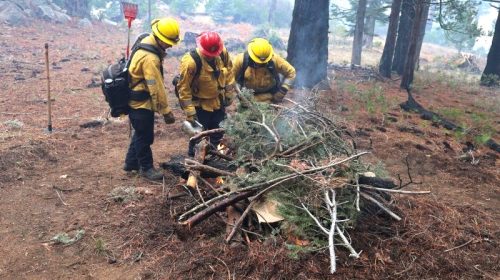
The Pineridge neighborhood is also currently inputting new systems to protect its residents from fire hazards in the future. This September, Bonny Doon Fire Safe Council approved a project clearing brush under power lines to ensure a safe escape route.
For Chris Homan, whose home burned down as well, after the fires the neighborhood went through a transformation that was beyond infrastructure. “There was a sense that we needed more community after the fire,” said Homan. “That we needed each other more.”
Homan says she became grounded in sharing the experience of losing her home with others in Bonny Doon. After the shock of the fire, connecting with others became part of the rebuilding process.
She’s part of a women’s singing group and regularly attends firewise events that are designed to help communities reduce the risk of fire damage. She says these are the things that give her hope.
“After the fire, there were a lot of events that brought people together,” Homan said. “We had pancake breakfasts, barbecues, Bonny Doon nights. I’d like to see those come back.”
Bonny Dooners showed up for each other for more than just events in the aftermath of the fires. Steve Homan, married to Chris, exemplified the community spirit in the work he did for his neighbors. After a 30-year career across three counties working as an environmental health specialist, Steve came out of retirement to help 50 of his neighbors who lost their homes navigate the red tape of the county’s environmental requirements. He is still helping one of them today.
“I got more out of it than it cost me,” said Homan. “I’ve been able to meet so many people and I’ve made some great new friends.”
Neighbors showing up for one another is not an uncommon story, many who were able to rebuild say they owe their good fortune to those around them who offered to help in a time where many were hurting.
One resident, who asked to be referred to as Mr. Moller, said a number of his neighbors drew from their life experience to pitch in. “A lot of people were willing to help,” said Moller. “My neighbor was a professional foreman. He was probably the most helpful.”
But the helping hands didn’t stop there. Moller had neighbors who were general contractors, who owned tractors, who had extra redwood trees and avocado trees he could plant on his property. For Moller, rebuilding meant being able to reach out for help from those around him.
Still, the number of homes that have been rebuilt is not even close to the number that burned in the CZU fires. Those who live in Bonny Doon and throughout the Santa Cruz Mountains are still dealing with trauma of such an incredible loss.
“There’s still a lot of grief, unresolved anger, and a sense of being stuck,” said Tonje
Wold-Switzer, the Executive Director of the Long-Term Recovery Group (LTRG) of Santa Cruz County, a nonprofit that coordinates with various organizations to provide disaster recovery services. “Financial hardship is a major factor. Most people were underinsured or completely uninsured. Some lost their homes and rental income, leaving them with no way to rebuild on fixed incomes.”
Wold-Switzer insists there is plenty more work to be done on the human side of rebuilding and that the LTRG — which is not associated with the county government — is making efforts in that direction.
“We need more spaces for grief and grievance — sessions where people can express these emotions,” she said. “We’re setting up local peer support groups with trauma-informed care, and connecting with other nonprofits providing online forums for disaster survivors.”
Regardless of what needs rebuilding, the physical homes or the sense of community itself, the bonds that Bonny Dooners shared with one another have shown to be vital in the slow and often painstaking process of rebuilding.
“It was a community willing to help, willing to go beyond what they would normally do,” said Moller. “I could not have rebuilt without the community of Bonny Doon.”
Learn more about the work of the Long Term Recovery Group at sccltrg.org.
Max Guerra
Max Guerralives and writes in Santa Cruz County, currently serving as Co-Editor-in-Chief of City on a Hill Press, the student-run newspaper at UCSC. He enjoys reporting on science policy, the politics of the environment, and any interesting people he happens to meet along the way.