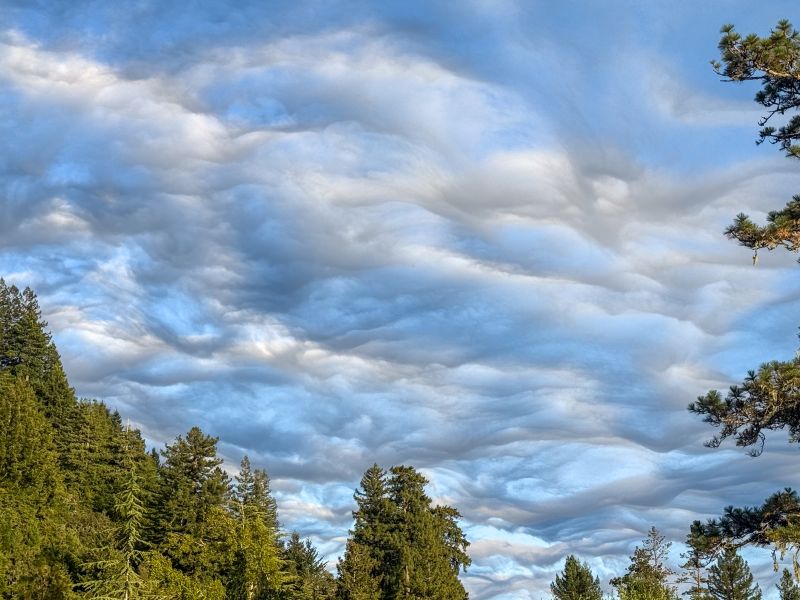
Wave‑Like Clouds Over the Santa Cruz Mountains
On a recent evening in the Santa Cruz Mountains, the sky looked more like the bottom of a rough ocean than a familiar blue dome. Those rolling, wave‑like clouds are an atmospheric feature called asperitas, shaped by invisible gravity waves and wind shear, and sometimes painted with pastel colors by a phenomenon known as cloud iridescence.
Asperitas is a relatively new addition to the official cloud atlas. In 2017, after years of documentation by citizen observers, the World Meteorological Organization recognized asperitas as a supplementary feature: well‑defined waves on the underside of otherwise ordinary stratocumulus or altocumulus clouds. The cloud base appears chaotic and churning, with localized waves and troughs that can resemble turbulent water seen from below.
Despite their dramatic look, asperitas clouds are usually low‑ to mid‑level clouds made of liquid water droplets. Recent studies show they tend to form below the freezing level and owe their structure to disturbances within the cloud layer itself. Three ingredients commonly show up when asperitas is observed: atmospheric gravity waves, wind shear, and a stable layering of air.
Gravity waves are ripples of rising and sinking air that move through the atmosphere when air is displaced in a stable layer and gravity pulls it back, much like waves on a disturbed pond. They are often launched by thunderstorms, weather fronts, or air flowing over terrain. When these waves pass through a moist stratiform cloud, they alternately thicken and thin the cloud, sculpting the underside into waves. Wind shear — sharp changes in wind speed or direction with height — further distorts the waves and adds the “choppy” texture that makes asperitas so striking.
On some days, the same clouds show soft bands of pinks, greens, and blues around the sun. That is cloud iridescence, a diffraction effect that occurs when sunlight passes through tiny, fairly uniform water droplets or ice crystals in a thin cloud. Different wavelengths of light are bent and interfere at slightly different angles, separating into pastel colors near the sun, especially where the cloud layer is thinnest.
Together, asperitas and iridescence turn a routine stratiform cloud layer into a vivid demonstration of how energy and moisture move through the atmosphere — waves and optics briefly written in the sky.
Photo by Christina Wise

The San Lorenzo Valley Post is your essential guide to life in the Santa Cruz Mountains. We're dedicated to delivering the latest news, events, and stories that matter to our community. From local government to schools, from environmental issues to the arts, we're committed to providing comprehensive and unbiased coverage. We believe in the power of community journalism and strive to be a platform for diverse voices.