PG&E Wants to Bury 157 Miles of Santa Cruz County Power Lines by 2037
Ben Lomond and Scotts Valley Circuits are Early in Line
By Mary Andersen
The utility’s new 10-year plan targets the county’s highest-risk mountain lines. State regulators still have to sign off, and customers would pay for it through their bills.
For people in the San Lorenzo Valley, overhead power lines have meant shutoffs on windy days, sudden “fast-trip” outages, and crews cutting back redwoods and oaks. Since the 2020 CZU Lightning Complex Fire, many have also worried that a line could start the next fire.
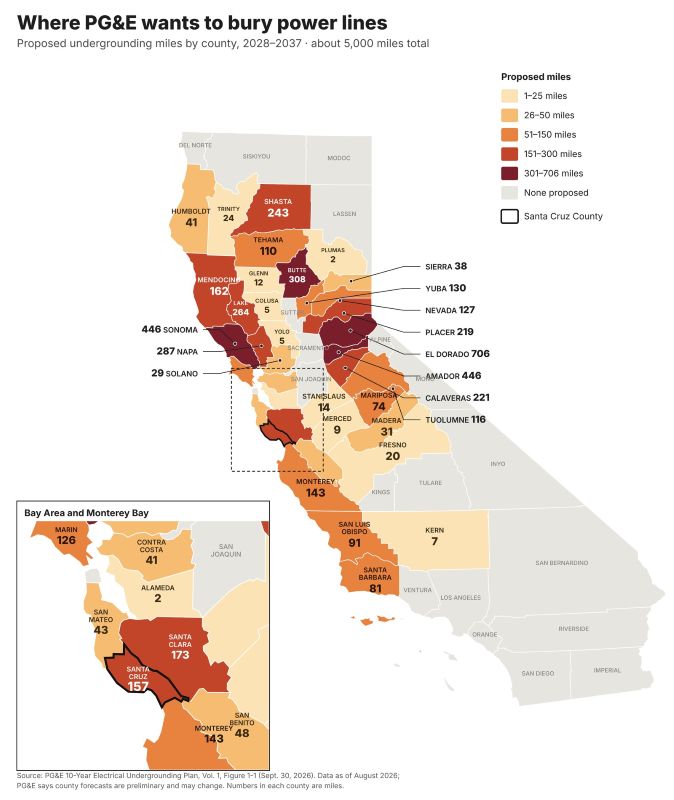
Pacific Gas and Electric Co. (PG&E) now says it wants to take a large share of those lines out of the trees. In a 10-year Electrical Undergrounding Plan filed Sept. 30, 2026 with the California Office of Energy Infrastructure Safety, PG&E proposes burying about 5,000 miles of distribution lines across Northern and Central California between 2028 and 2037. That includes 157 miles in Santa Cruz County, concentrated in the state-designated high fire-threat areas of the Santa Cruz Mountains.
What’s planned here
The 157 miles would be a big jump from what has been built so far. Since 2021, PG&E says it has buried about 10 miles of line in Santa Cruz County and hardened another 41 miles with stronger poles and covered wire. That total includes one mile of each due to be finished this year.
Most of the plan is still a forecast. PG&E calls its county mileage “preliminary” and says it will change as projects are designed, permitted and approved. The filing does not include a street-by-street list. It does name 28 “Portfolio 0” projects statewide that are furthest along in planning, and three are in Santa Cruz County:
| Circuit (named for its substation) | Segment length | Area |
| Ben Lomond 0401 | 7.7 miles | San Lorenzo Valley |
| Camp Evers 2105 | 4.9 miles | Scotts Valley area |
| Camp Evers 2105 (second segment) | 3.4 miles | Scotts Valley area |
PG&E names circuits after the substation that feeds them, not the streets they run along. Residents should not assume a circuit covers only the town in its name. PG&E’s undergrounding pages, linked from pge.com/eup, include maps of planned and active work.
Together, the three local projects cover about 16 miles. A fourth early project is just over the Summit: 8.2 miles on the Los Gatos 1107 circuit in Santa Clara County.
PG&E also scored each project on whether it is worth the money. The company compared the estimated cost of burying each line with the wildfire and outage damage that burying it should prevent. By PG&E’s math, every $1 spent on the Ben Lomond project would prevent about $3.40 in damage. The two Camp Evers segments score higher, at about $4.70 and $21 per dollar spent.
PG&E has done local undergrounding before. Lines have gone underground along Swanton Road and parts of Highway 236 northwest of Boulder Creek, where many homes burned in the CZU fire.
Fewer shutoffs, less tree trimming
The biggest change for mountain residents could be fewer outages. PG&E says buried lines have about 90% fewer outages. It also says they cut wildfire ignition risk on those lines by about 98%.
The filing says underground lines can also eliminate the need for Public Safety Power Shutoffs and Enhanced Powerline Safety Settings on those lines. Those safety settings are the sensitive “fast-trip” settings behind many unexplained summer outages in the valley. Buried lines also need far less clearance work. PG&E projects about $6 billion in avoided vegetation management, operations and maintenance costs statewide over the life of the lines.
The plan does not bury every line. PG&E says it ranks segments using wildfire likelihood and consequence, outage history, cost and how undergrounding compares with other options. Where burying a line doesn’t pencil out, PG&E may use stronger poles and insulated “covered” wire instead. Those options are cheaper and faster but don’t cut risk as much.
Smaller than the 2021 pledge
The plan is smaller than the goal PG&E announced in 2021, after one of its lines sparked the Dixie Fire in the northern Sierra. Back then, the company promised to bury 10,000 miles of line. By the end of 2027, it expects to have about 1,900 miles underground. Adding the new plan’s 5,000 miles brings the total to roughly 7,000 miles by 2037.
PG&E rejects the idea that this is a scale-back. A company spokesperson told local media the filing is “the next phase” of its wildfire work. Counting stronger poles and covered wire, PG&E says it will have buried or upgraded more than 11,000 miles of high-risk line by the end of 2037.
Across the region, the plan includes about 157 miles in Santa Cruz County, 173 in Santa Clara County, 43 in San Mateo County and roughly 140 in Monterey County. Statewide, El Dorado (706 miles) and Sonoma (446) lead the list.
What it costs and who pays
PG&E puts the construction cost at about $11.4 billion in today’s dollars, or about $16.6 billion in the dollars that would actually be spent from 2028 to 2037. That works out to roughly $3.3 million per mile.
Customers, not PG&E shareholders, would pay that bill. Like other long-term construction, the cost would be added to rates and repaid over the decades the lines are in service. PG&E would also earn a regulator-approved profit on it. Tree trimming works differently: it’s a yearly expense that PG&E passes on at cost. The cost would be spread across PG&E’s electric customers, so households in Santa Cruz and Watsonville would help pay for lines buried in the mountains.
How much bills would rise isn’t known yet, and the filing doesn’t estimate it. That number should come when PG&E asks the CPUC to approve the costs, likely in 2027. The commission will also set yearly spending caps then, and the public can comment during that review.
PG&E says the work is worth about $117 billion in avoided wildfire and outage losses, more than 10 times the cost. That figure deserves a closer look. It assumes a world without the shutoffs and fast-trip settings PG&E uses now. The filing also runs the numbers the way state regulators require, with those programs in place. On that basis, the benefit is about $15.1 billion, roughly 1.3 times the cost.
PG&E says it has cut its cost per mile by about 25% in recent years and expects a decade-long plan to lower costs further. Local skeptics have long questioned the price. In 2023 the Bonny Doon Fire Safe Council’s president called the cost “staggering” and said he preferred insulated overhead lines.
The filing also arrives while PG&E is under financial strain. In September, the company said it would defer about $2 billion in spending next year while state lawmakers debate how wildfire liability costs are handled.
What happens next
No trenching is coming under this plan before 2028. The approval process has two steps, set up by the 2022 state law SB 884:
- Energy Safety review. The Office of Energy Infrastructure Safety has nine months to approve, deny or require changes. It must find that the plan substantially reduces wildfire risk and substantially improves reliability. The filing is docket EUP-PGE.
- Cost review. If Energy Safety approves, PG&E has 60 days to ask the California Public Utilities Commission to approve the costs. The CPUC then has nine months to decide.
PG&E filed corrections to the plan on Oct. 12. It posts the plan, county work list, corrections and regulators’ questions and its answers at pge.com/eup. Questions go to EUPinfo@pge.com, and PG&E says it responds within three business days. PG&E will also post progress reports every six months once the plan starts.
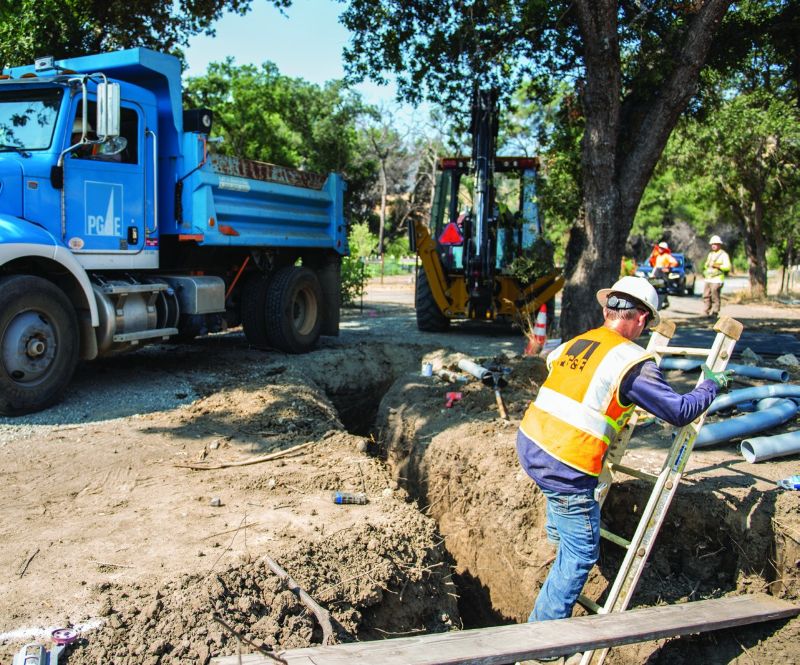
Featured photo: Crews trench beside a river to bury a power line during an earlier PG&E project. PG&E’s new plan would bury about 5,000 miles of line in high fire-risk areas statewide, including 157 miles in Santa Cruz County.
Photo courtesy of PG&E

The San Lorenzo Valley Post is your essential guide to life in the Santa Cruz Mountains. We're dedicated to delivering the latest news, events, and stories that matter to our community. From local government to schools, from environmental issues to the arts, we're committed to providing comprehensive and unbiased coverage. We believe in the power of community journalism and strive to be a platform for diverse voices.