The Bored Puppy Problem
How to Keep Your New Puppy Happy
By Gale McCreary, Whinny Hill Aussies
A bored puppy can be a problem puppy. If as you’ve heard, one dog year equals seven human years, then one day in the life of a puppy is like a week. And when you leave your new puppy home alone for one hour, it’s like a full workday. Successfully raising an eight-week-old baby puppy requires constant attention: taking them out hourly for potty training, feeding them 3-4 times a day, supervising their rapid cycles of naps and wakefulness, and managing their transition into your household.
Remember that your puppy has just left a litter of energetic siblings who have provided constant entertainment. They’ve spent much time racing around wildly, destroying any toy or pillow that’s available to them, chewing on each other, climbing on their barriers, and plenty of good old-fashioned wrestling. They run and play until they’re exhausted and then fall into heaps of slumbering puppies.
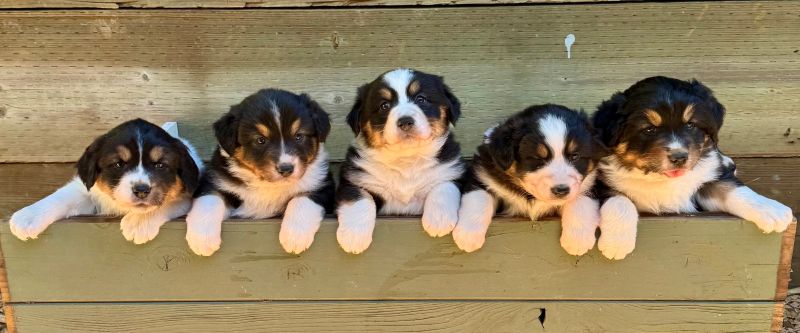
You will bring your puppy into a civilized home of humans, and it will be a complete culture shock. Furthermore, the people in your life may vary from little kids to older adults, and each one of those brings a different experience to your puppy.
Naturally, you must watch the youngsters as they may think the puppy is nothing more than a play toy or another stuffed animal. They must recognize how fragile a puppy is and vulnerable to being hurt. By the same token, puppies are equipped with razor-like needle “puppy” teeth, which in a few months will be replaced by smoother “grown-up” teeth, but at the time you first bring your puppy home, can rip holes in your clothing and tears in your skin. Unwittingly, the puppy may inflict some painful bites on you and your children, which are no different from the painful bites it has been inflicting on its siblings for the last month. Your job is to provide it a balance of rest and stimulation, and gentle instruction on your boundaries.
A walk on a leash is not a puppy’s idea of stimulation. Playing on the floor, gently tugging on toys, making up little games of chase are fun for a puppy. Being dragged on a leash through a paved neighborhood is not. As your puppy grows, introducing these new walks and outdoor experiences will be well accepted. A romp in the garden is always a joy, for there are bushes and grass and many new things to explore. Like a human baby, most everything will find its way into your puppy’s mouth for tasting, so be aware of the toxic plants and the potential fertilizers and rodent poisons that your puppy might get into.
Do not assume that by turning your puppy into a well-fenced backyard that your puppy is fully entertained. After long, it will begin to explore its boundaries, probably a fence, and wish to go beyond them. Left alone, your puppy may be the type who runs the fence line or barks incessantly at anything passing by. These are not bad behaviors; these are simply bored behaviors. Digging in the yard is not only natural for a dog, but extremely fun for a puppy.
Some do it more than others, as some chew on the trunks of your trees, and on the wooden steps, and on the hoses. Most all puppies adore drip irrigation.
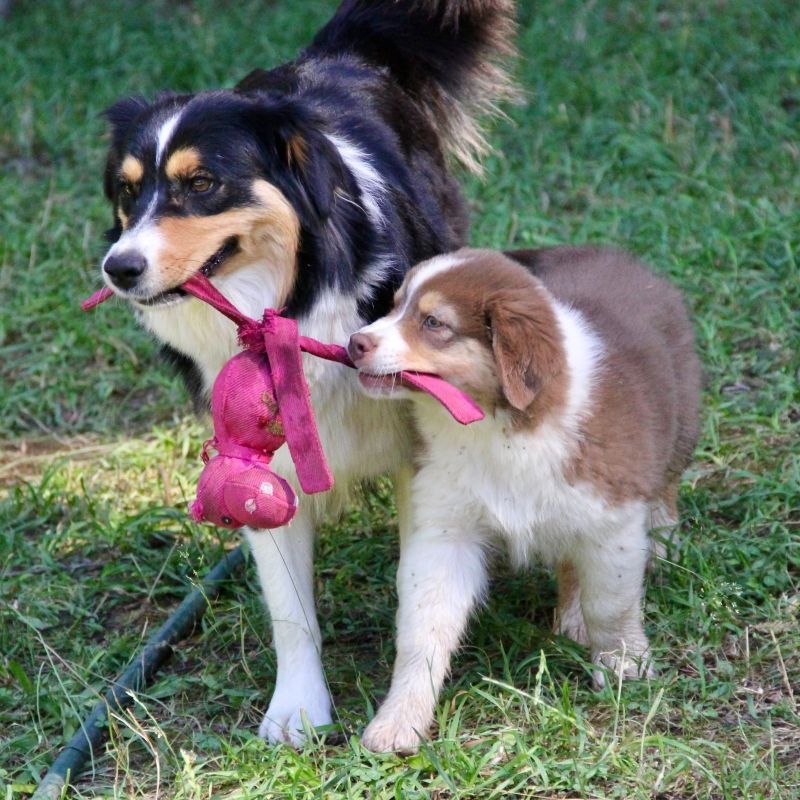
Offer toys in a dedicated space so that the puppy knows those are his toys, not to be confused with slippers, bed pillows, or children’s toys. You will be amazed how quickly a puppy can completely unstuff a stuffed animal, after which you should simply put it in the trash and buy another one at the Dollar Store or on sale. Just like a human child, watch for button eyes or plastic pieces that quickly will be chewed off and possibly choked on.
If you have an existing dog, bring that puppy home while it is still a part of your family. Even an older dog will not only discipline the puppy, but provide the entertainment that you cannot in between your own playtime. The fastest way to tire out a puppy is a playdate. After the 4-month vaccinations, connect with another pup, especially a sibling. Nothing is more fun than going back to the original form of dog wrestling and exploring than doing it with a buddy.
I’m writing this so that you do not feel that you have a bad or naughty puppy. With enough activity and entertainment and time with you, the opportunities to be destructive will lessen, and the natural behaviors will be outgrown. (I’ve also talked with owners who tell me their puppies never exhibited any of these antics and not one shoe or carpet was ever destroyed. Those are the exceptional ones.) Your puppy really wants to be your best friend.
Take consolation that by the time your puppy reaches 18 months, most of these natural behaviors will have diminished. “18 months,” you’re thinking, “that’s a year and a half!” Yes, taking on a new 8-week-old puppy is definitely a responsibility.
Follow Whinny Hill Aussies on Facebook.

Gale McCreary
Gale McCrearyis the Founder and Chief Coordinator of SpeechStory, a nonprofit organization focused on helping youth improve their public speaking skills. She previously was Founder and CEO of a healthcare IT company, where she was recognized as Santa Barbara Entrepreneurial Woman of the Year and received Congressional recognition for providing a Family-Friendly work environment. She has a BS in Biology from Stanford University. Gale resides in Felton with horses, ducks and Australian Shepherds.