Valley Homes in Motion
How the Market Expanded, Contracted, and Repriced Over the last 25 Years
By MaryBeth McLaughlin
When I’m out showing property, I hear a version of the same comment almost every week: “Wow… prices have really gone up around here.” But what’s just as true is that compared to Santa Cruz, Silicon Valley, or much of the Bay Area, the San Lorenzo Valley is still one of the more attainable places to buy a home.
You may trade walkability for winding roads. You may drive a little farther for groceries or commute. But what you gain — space, privacy, access to nature, good schools, and a sense of community — is exactly why people continue choosing to live here. Over the past 25 years, that balance has evolved.
The Valley Market
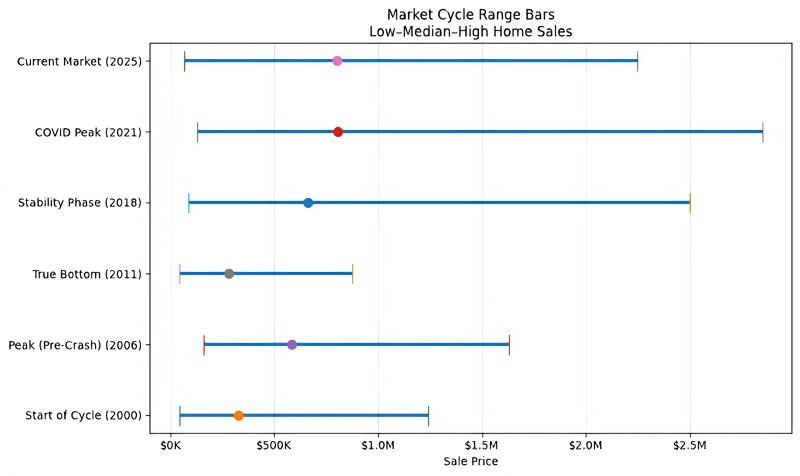
Each line in the chart above shows the full range of home sales in a given cycle, with the dot marking the median. Notice how the market compresses around 2011, then expands significantly in the years that follow.
In the early 2000s, the Valley was a different kind of market. In 2000, home sales ranged from approximately $42,000 to $1.24 million, with a median price around $327,500. There was a wide spread, but the majority of homes still clustered in the more accessible end of the market.
By 2006, at the peak of the pre-recession expansion, that entire structure shifted upward. Median pricing rose to $585,000, and top-end sales pushed past $1.6 million.
As lending tightened and buyer confidence pulled back, both activity and pricing declined. But more importantly, the range of the market compressed. By 2011 — the true bottom — the highest sale in the Valley was under $900,000, and the median had dropped to $280,000.
Recovery and Expansion
From that 2011 bottom, the Valley began to rebuild. At first, gradually. Then more confidently. By 2018, the market didn’t just recover — it expanded beyond where it had been before. Home sales ranged from under $100,000 to over $2.5 million, with a median around $660,000.
Then came 2021. Nearly 500 home sales. Prices stretched from $130,000 to nearly $2.9 million. The widest range in the entire 25-year dataset. The pandemic didn’t start the shift — it sped up what was already happening.
Today: A Wider, More Layered Market
Since that peak, activity has slowed. Sales numbers have returned to the mid-200s. But the structure has held. In 2025:
- Entry-level still exists
- High-end still reaches above $2M
- Median remains around $800K
Even now, the Valley offers something increasingly rare: A range of entry points paired with a lifestyle people actively seek out.
In the mid-2000s, most home sales in the Valley happened below $750,000. Today, fewer homes sell under $500,000, while a growing share of buyers are purchasing between $750,000 and $1 million — and increasingly above that. This isn’t just about prices rising. It’s about where the majority of the market now lives — and how the Valley has repositioned within the broader Bay Area housing landscape.
What’s Changed
- The true cost of ownership has gone up. Not just purchase price — what it takes to maintain and improve a property over time.
- Remodeling and updating older homes is more expensive. Many SLV homes were built decades ago. Roofs, siding, foundations, and interiors often need updating — and those costs have risen significantly.
- Access and infrastructure improvements are more front-of-mind. Driveways, road maintenance, drainage, and usability are factoring in early.
- Stewardship of the land is getting more attention. Since the fires, more homeowners are actively managing defensible space..
- Insurance requires more awareness — but solutions exist. Some areas rely on the California FAIR Plan, while others still qualify for traditional coverage. In some cases, neighbors are working together toward Firewise-style improvements to strengthen insurability over time.
What Still Holds True
- Different buyers are drawn to different ways of living here. Some want full sun and space to grow gardens. Others prioritize views and openness. Some are drawn to shaded, creekside settings with redwoods and ferns. And others want to be closer to town and daily conveniences.
- Usability matters more than raw size. A smaller, functional property often wins over larger but more challenging terrain.
- The “feel” of a property still drives decisions. Privacy, quiet, and connection to the land remain at the heart of why people choose the Valley.
- Pricing realistically still determines outcomes. Regardless of the cycle, homes aligned with condition, location, and access are the ones that move.
People choose the San Lorenzo Valley — not just for what it costs, but for the way of life it offers: a little more space, a little more quiet, and a closer connection to the land.
Data sourced from “MLS Listings” residential sales, Areas 34–38 (2000–2025).

MaryBeth McLaughlin
MaryBeth McLaughlinis a local Realtor specializing in mountain and rural properties throughout the Santa Cruz Mountains. She brings humor, heart,and hard data to every transaction — and now to her new monthly column.