Pickled Eggs: A Call for Their Return
By Tom Andersen
Are the days of peanuts and pickled eggs at the bar really over? I hope I’m wrong, but have a look around; they’re part of a by-gone era. Didn’t seem that long ago one could have a seat at Joe’s or the Boulder Club in the Rex Hotel, George’s Log Cabin (now Monte’s) or even the old Woodshed in Felton and have a few mugs of a good old American Pilsner and a couple of pickled eggs. Ya gotta have your protein with your carbs for complete nutrition. Who knows, you may even be compelled to do a little dancing (except at George’s where the sign clearly stated “NO DANCING”). Seems like the only place you’ll find pickled eggs anymore are at church socials and potluck dinners.
Well, I’m making a call for their return! The last maybe 10 years have seen a surge in home raised chickens and more recently, ducks. Sometimes some kinds of ducks can lay eggs year round but chickens, unless you trick them with heat and light, give it up in the dark months of winter. They aren’t the brightest birds in the aviary so they are pretty easy to fool. I like to give my hens a little break. They earn their keep all summer long.
Go ahead and fool the poor girls if you must but there are a few ways to preserve eggs through any season. They freeze just fine and you can salt cure the yolks into solid little nuggets for grinding into egg dust or grating on to all sorts of things. Or, you can pickle them in vinegar or better yet, ferment them with herbs, pickled pepper juice, pickled beet juice or whatever lights your fire.
Fermenting your eggs takes two steps. The first and probably the most important is making hard boiled eggs without that sulfur smell or the dark ring around the yolk. The second is getting a good safe fermentation. Because the eggs are cooked, they do not have any lactobacillus on them so we have to add a little to get them going in good time. Any active pickle brine or even homemade or other vinegar with the mother will work. I’m told that even kombucha with active cultures will work. The brine for eggs needs to be a little stronger than most pickles. 3% to 4% is appropriate — not to worry though, the eggs can handle it.
To get good hardboiled eggs, start with room temperature eggs and boiling water. Poke a little hole in the round end of the eggs to let the pressure out. Use a pin. Boil enough water to cover the eggs. Gently place the eggs into the water then turn it down to a high simmer (tiny bubbles). Boil them for ten or twelve minutes. In the meantime, make an ice bath. We want really cold water to stop the cooking and to draw out the sulfur smell and that dark ring around the yolk that often happens. After a few minutes in the ice bath, grab an egg and crack the shell. Peel them under running water. The running water gets between the shell and the white. The shell slips right off (most of the time).
Next, you need a brine. I made two for this article. Each is for 6 eggs. For the first, you’ll need about 2 cups of pure water and about 4 tsp of non-iodized salt. I use sea salt. Gochugaru, the hot pepper flakes from Korea are fun, but regular pepper flakes are great. I used 4 tsp. I also added 2 tsp of homemade fermented jalapeno pepper sauce because I like it spicy. The homemade pepper sauce would have been enough to start the fermentation, but I added 1/2 cup of homemade apple scrap vinegar with some mother to really give it a boost.
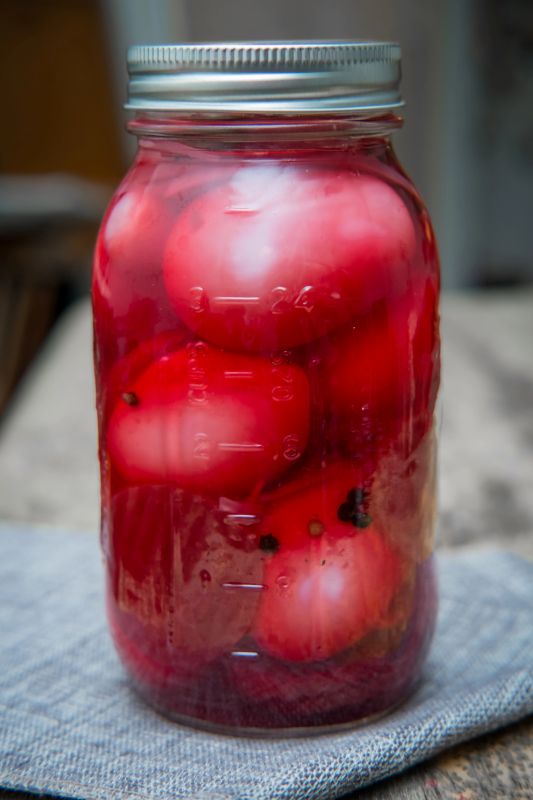
Put the eggs into a quart jar and add the spices. Fill the jar with the brine leaving at least an inch from the top. Put something in to hold the eggs under the brine (very important!). Put the lid on and flip it around to stir it up well. Place in a cozy place — warm, not hot, and in dim light rather than direct sunlight — for a few days. Loosen the lid at least once a day as it ferments. It takes at least three days to get the job done but more time makes them more sour. Store any leftovers in the fridge.
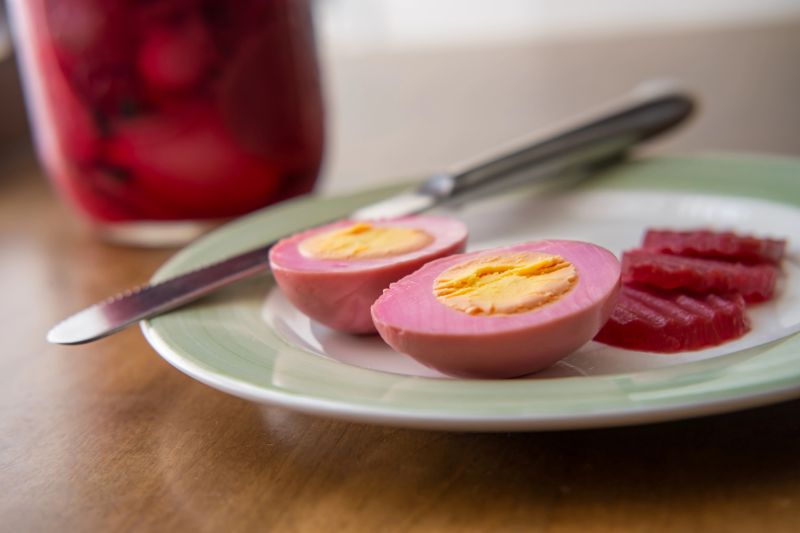
The second recipe is by request from a reader. Using beet pickle juice (beet kvass) makes for really cool looking eggs. I made beet pickles and filled the quart jar full of eggs about ⅔ full with the brine. For the remainder, I made a strong brine of 2 tsp of salt per cup of water. Fill the jar and ferment as above. If you want, add some herbs like rosemary, thyme and/or oregano.
From these beet pickled eggs, I made deviled eggs. I scooped out the yolks, added 2 T of good mayo, ½ tsp of homemade mustard I got from a friend (not yellow hotdog mustard), a big pinch of salt and pepper and ½ tsp of oregano. Whip it all up and spoon it back into the whites. The whole thing is purple — unique for sure.

Thomas Andersen
Tom Andersen is a writer, cook, martial arts instructor and lifelong Felton resident. He explores the world of fermented food and drinks in print and online. Tom lives in Felton with his family and many pets. He is currently working on a cookbook about fermentation.